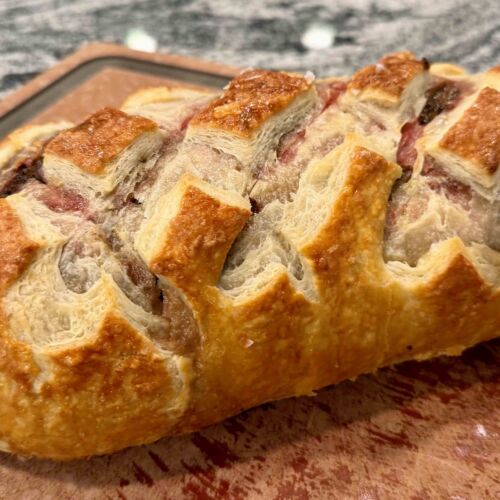
Beef Wellington
Worth every layered step
Ingredients
- 1 center-cut beef tenderloin, trimmed of silverskin and fat, about 2 pounds see Notes
- 2 tablespoons neutral oil
- 2 tablespoons prepared horseradish
- 1 tablespoon Dijon, spicy brown or hot English mustard
- 1 pound mushrooms (button, cremini, shiitake, portabello, or a mix) cleaned, trimmed, and roughly chopped
- 4 tablespoons unsalted butter
- 2 medium shallots finely diced (about 1/2 cup)
- 2 teaspoons finely minced fresh thyme leaves
- 1/2 cup Cognac or other brandy
- 1/2 cup heavy cream
- 2 teaspoons soy sauce
- 4 ounces pork and duck liver pâté or mousse see Notes
- 1 sheet phyllo dough
- 1/4 pound prosciutto, sliced paper thin
- Flour for dusting
- 14 ounces frozen or homemade puff pastry thawed see Notes
- 1 large egg beaten
- Kosher salt and freshly ground black pepper
- Flaky (such as Maldon) or coarse sea salt
Instructions
Cooking:
- Using butcher's twine, tie the tenderloin at 1-inch intervals. Trim ends of the twine. Season liberally with Kosher salt and freshly ground black pepper.
- Heat 2 tablespoons of oil in a 12-inch cast iron or stainless steel skillet over high heat until smoking. Add the tenderloin and cook without moving until well-browned on the first side, about 2 minutes. Rotate tenderloin and continue cooking until browned on all sides, about 10 minutes total. Transfer to a large plate. Set the skillet aside.
- Combine the horseradish, mustard, and 1 teaspoon black pepper in a small bowl. When the tenderloin is cool enough to handle, cut off and discard twine, then rub on all surfaces with horseradish/mustard mixture. Place in the refrigerator, uncovered.
- Place half the mushrooms in the bowl of a food processor and pulse until very finely chopped, scraping down sides and redistributing the mushrooms with spatula as necessary, about 10 short pulses. Transfer to a bowl. Repeat with the remaining mushrooms.
- Using the same skillet, heat the butter over medium-high heat until melted. Add the mushrooms and cook, stirring occasionally, until the mushrooms have exuded all their liquid and start to sizzle, about 8 minutes. Continue cooking until the mushrooms begin to brown and leave browned bits stuck to the bottom of the pan, about 4 minutes longer.
- Add the shallots and thyme and cook, stirring frequently, until softened, about 2 minutes.
- Add the brandy. Scrape the bottom of the skillet with a wooden spoon to release any browned bits. Continue to cook until the brandy is nearly dry, about 4 minutes.
- Add the heavy cream and soy sauce and continue to cook, stirring frequently until mixture is thick and collects in one large mass when you shake the skillet. Season to taste with salt and pepper. Transfer to a bowl and place in the refrigerator. (See Notes.)
Assembling:
- Lay a double layer of plastic wrap about 2 feet long and 1 foot wide on the counter. Lay phyllo dough on top of plastic wrap. Shingle the prosciutto on top of phyllo to create a thin, even, overlapping layer, leaving a 2-inch border along the bottom and top of the phyllo dough. Spread the mushroom mixture evenly over the prosciutto layer.
- Place the tenderloin along the very bottom edge of the prosciutto/mushroom layer. Spread the pâté on top of tenderloin. Carefully roll the tenderloin on the mushroom, prosciutto and phyllo (it’s okay if this cracks a bit), using the plastic wrap to help tighten it as you roll. Once the beef is completely rolled up, re-wrap with more plastic wrap, twisting the ends to make sure the roll is very tight. Return to the refrigerator for at least 30 minutes.
- Dust the countertop lightly with flour. Spread the puff pastry on the counter and, using a rolling pin, roll it into a rectangle at least 4 inches wider than the beef roll on its shorter side.
- Unwrap beef roll and place it along the very bottom edge of puff pastry with the pâté side facing up. Brush 6 inches of the puff pastry just above the beef roll with the beaten egg (save the remaining egg for the top of the pastry). Carefully roll the beef in the puff pastry until it is completely wrapped. You should end up with the pâté-side facing up again (if you can’t tell, don’t worry), with the puff pastry seam meeting on the bottom. Trim pastry with a sharp knife.
- Fold sides of the puff pastry protruding from either end of the beef roll towards the center, then fold the top flaps down. Trim off the bottom flaps carefully. (It’s kind of like wrapping a present.)
- Roll the entire beef roll over so that the bottom is facing up, then fold up the end flaps to seal completely. Roll beef back right-side up. Transfer to a plate and chill for at least 30 minutes. (See Notes).
- Preheat the oven to 425°F. Adjust the oven rack to center position.
- Transfer the Beef Wellington to a parchment-lined baking sheet and brush all over with remaining beaten egg.
- Use a sharp paring knife to lightly score (do not cut all the way through) a decorative pattern in the pastry.
- Sprinkle liberally with flaky or coarse salt.
Baking:
- Bake until pastry is golden brown (and puffed) and center of roast registers 110°F for rare or 120°F for medium-rare on an instant-read thermometer, 35 to 45 minutes. Remove it from the oven and allow it to rest for 10 minutes.
- Use a thin metal spatula to loosen Wellington from parchment paper, then carefully transfer it to a carving board. Slice off the ends with a sharp knife. Carve the Beef Wellington and serve.
Notes
- This is based on J. Kenji López-Alt’s recipe for The Ultimate Beef Wellington—I highly recommend reviewing his recipe as it has step-by-step photos.
- For the beef, a center-cut beef tenderloin is also known as a Châteubriand. If you’re using a butcher, ask them to tie the beef for a Beef Wellington. Two pounds of beef is just right for 6 people—you need less beef than you would if you were serving a simple tenderloin given the other ingredients that make up Beef Wellington.
- The mushroom mixture could be prepared 1 day in advance and refrigerated.
For the pâté, I used Three Little Pigs’ Mousse de Foie de Canard au Porto (available at Whole Foods and Wegmans). - For best results, use a high-quality all-butter puff pastry, such as Dufour (I found it at Whole Foods). You need 14 ounces—don't try to make this with less.
- You can prepare the Beef Wellington through the pastry wrapping step up to a day in advance. It’s fine to let it sit in the refrigerator uncovered for a few hours before cooking. If it's longer, wrap it in plastic wrap.